
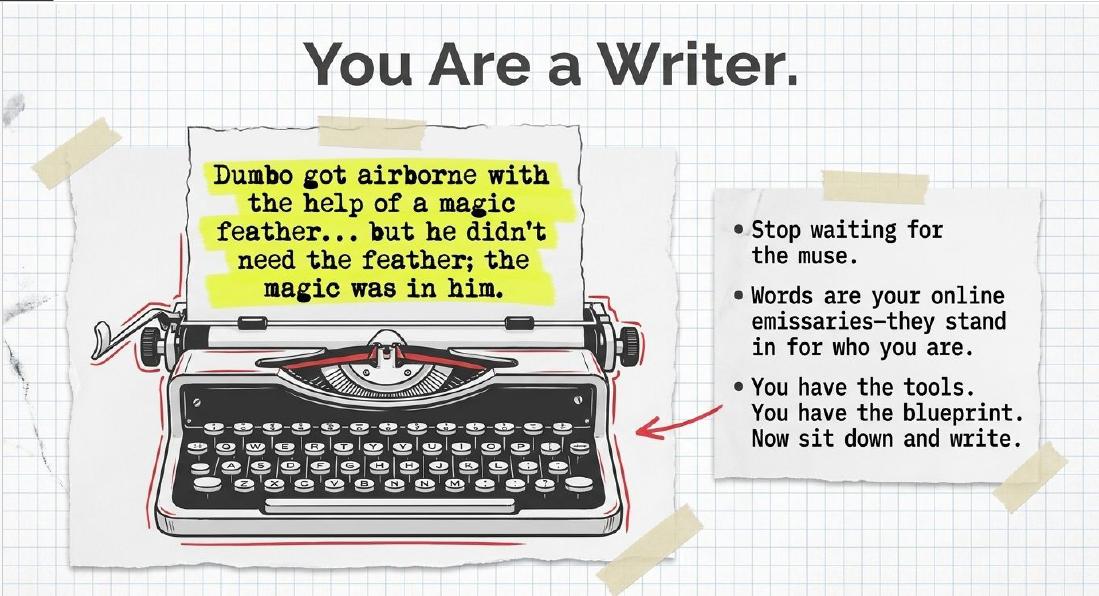
If your business has a website, sends email newsletters, publishes blog posts, posts on social media, or creates sales materials, you are already in the writing business.
That does not mean you need to become a novelist. It means the words your company publishes matter.
Good content writing can help people understand what you do, trust your expertise, find you through a search engine, and ultimately take action. Bad content can make a good business sound generic.
Recently, I was putting together a lecture on writing, and came across Ann Handley’s Everybody Writes. A few of the themes in the book really stuck with me. One of the central ideas is that writing is not some mysterious talent you either have or don’t have. It is a skill you can improve through a better process.
I agree with that. But I also think businesses need to take the idea further today.
Generative AI tools like ChatGPT and Google Gemini have made it incredibly easy to create average content. The challenge is no longer producing enough words. The challenge is producing something useful, distinctive, and worth paying attention to.
If this sounds like something your company should be contemplating, then here are the content writing principles I think matter most so you can put them into practice.
My Top Content Writing Tips for Businesses
- Write for your customer, not your company
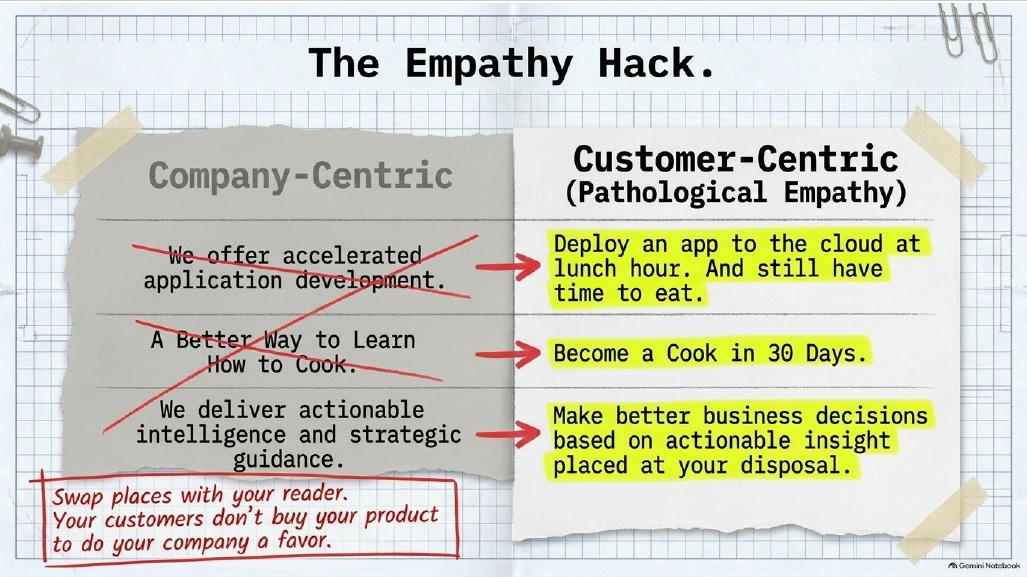
Businesses naturally write from the inside out. They talk about their platform, features, technology, methodology, awards, or years of experience.
Customers usually care about something much simpler:
What does this do for me?
One exercise from Ann Handley’s Everybody Writes I used on the writing session was the “So What?” cascade. Start with the message your company wants to communicate, then keep asking “So what?” until you arrive at a result the customer actually cares about.
For example:
“We built collaborative editing software.”
So what?
“It helps teams work together.”
So what?
“People stop overwriting each other’s work.”
So what?
“Your team gets work finished faster with less frustration.”
The last version is stronger because it describes an outcome.
This should guide everything from web copy and blog content to social media copy and email copy. Before you publish, ask yourself: What does the reader get from this?
If you cannot answer that clearly, keep working.
- Build your content strategy around real customer questions
Keyword research is useful. As an SEO specialist, this is central to my work, of course, but it should not be your only source of ideas.
A search engine can tell you what people are searching for. Your customers can tell you why they care.
I always encourage my clients to listen to sales calls. Look at recurring customer emails. Ask your team what objections come up repeatedly. Review the questions people ask before they buy.
Those questions can become blog posts, case studies, email newsletters, podcast scripts, social media posts, white papers, podcast show notes, or sections of your website. That is a much stronger content strategy than publishing because your calendar says you need “three posts this week.”
It also helps you understand different buyer journey stages. Someone discovering a problem needs different information from someone comparing providers and deciding whether to buy.
Your content should reflect that.
- Create audience personas from reality
Audience personas can help, but only when they are based on evidence.
I would rather know about three real customers than read a fictional profile telling me that “Marketing Mary enjoys yoga and drinks oat-milk lattes.”
During the lecture, we discussed asking businesses to describe their favorite customers: why they were a good fit, what problem brought them in, what questions they asked, and what mattered to them.
Those stories can reveal useful patterns. Use those patterns to build audience personas, then test your writing against them. Would this person understand the headline? Does the article answer something they actually care about? Would they know what to do next?
That is customer research you can actually use.
- Make your company sound like your company
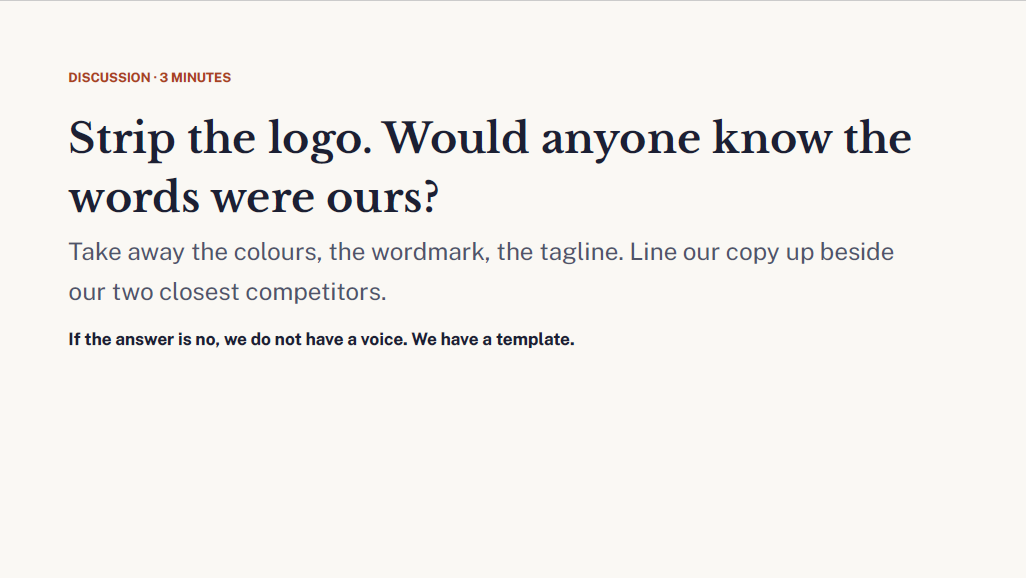
Handley has a simple brand-voice test that I shared in the session: Remove your logo, colors, company name, and tagline from your website. Put the copy beside two competitors. Could someone tell which one is yours? If not, you may have a visual brand, but you do not have much of a voice.
That matters even more now because generative AI can make companies sound increasingly alike. My personal take is not to avoid AI, but rather give AI better material.
Use sales conversations, founder language, customer questions, internal expertise, real examples, proprietary research, and clear opinions. These are things competitors cannot easily duplicate.
That specificity is what builds brand authority.
- Pick the format based on the job
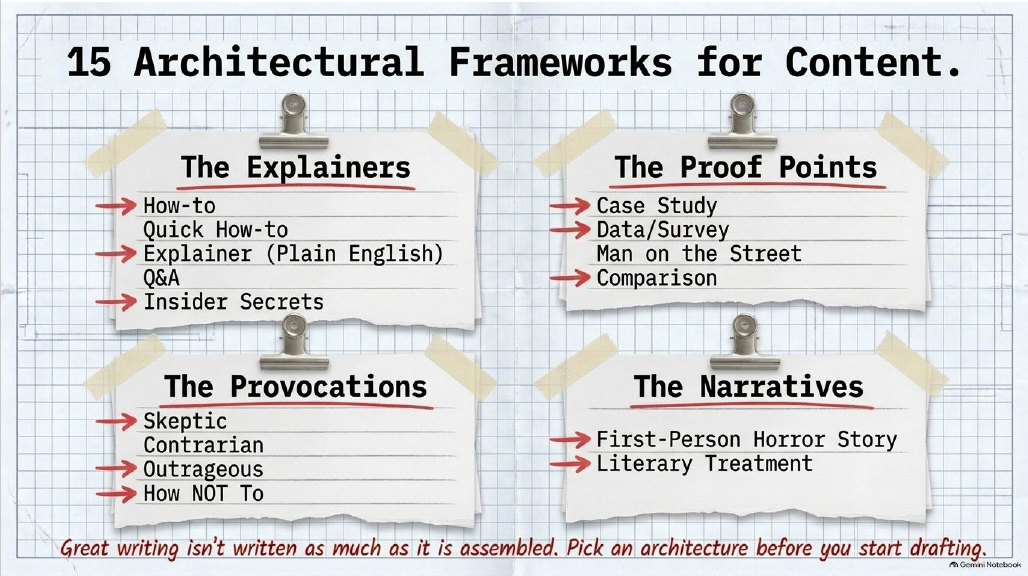
Not every idea needs to become a 2,000-word article. Start by asking what the content needs to accomplish.
If someone needs proof, a case study may work better.
If the subject needs depth, long-form content or a white paper may make sense.
If you want to keep prospects engaged, email newsletters can work.
If you have proprietary research, it might become a blog post, press release, social content, or even support outreach to media outlets and media placements.
If you’re an eCommerce, make sure your product category descriptions help people choose and buy. It might seem trivial, but every written section can and should matter.
The format should follow the objective.
Think of it like this: What is the job of this piece of content? If you cannot answer that in one sentence, the problem may be your strategy rather than your writing.
- Write the ugly first draft
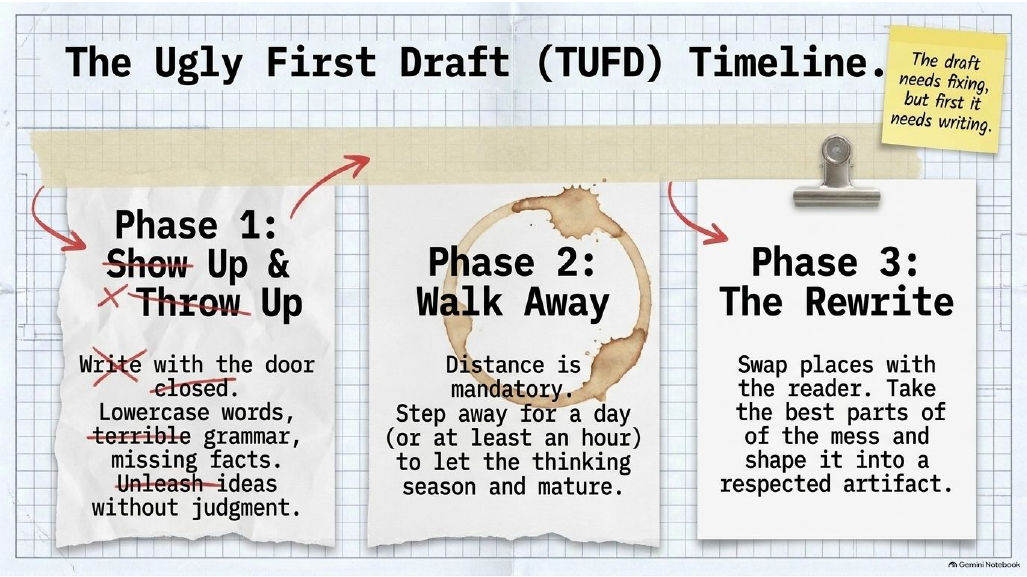
One of the ideas from Everybody Writes that I like most is the ugly first draft.
The goal is not to intentionally write badly. The goal is to stop trying to write and edit at the same time.
Get the idea onto the page.
Walk away.
Then come back and improve it from the reader’s perspective. A blank Google Docs page cannot be edited, an imperfect draft can.
If your writing starts sounding too corporate, try explaining the idea as if you were writing to one person you know well. Handley suggests a simple shortcut: start with ‘Dear Mom.’
You probably would not tell your mother that your company “leverages innovative solutions to optimize organizational outcomes.” You would explain what the company actually does.
That is usually the better sentence.
- Edit with a chainsaw before a scalpel
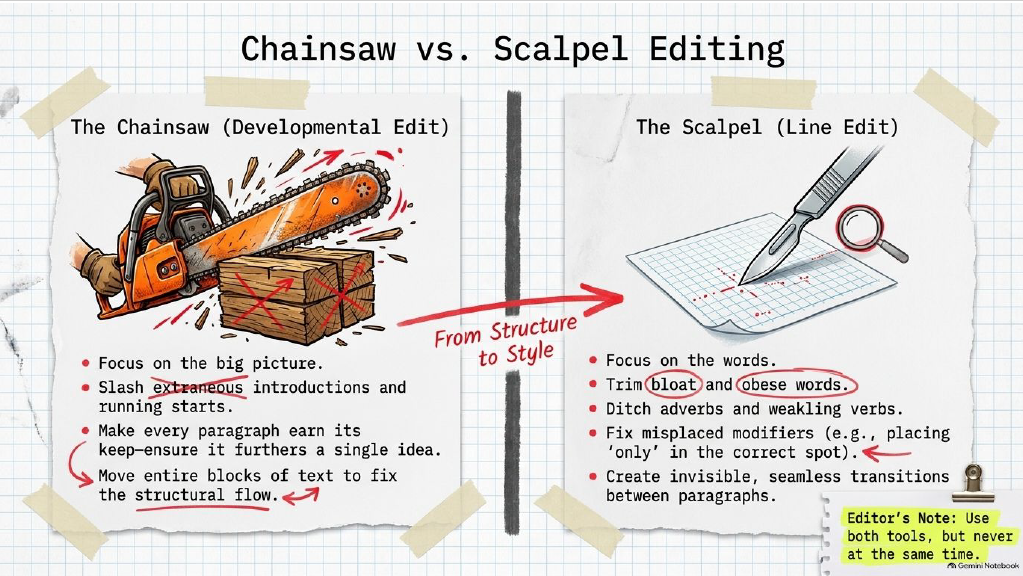
Most writers start editing too small.
They fix commas while ignoring entire sections that should not exist. Handley separates self-editing into two stages: developmental editing with a ‘chainsaw,’ followed by finer editing with ‘surgical tools.’ I used the same distinction in the session because it gives businesses a useful order for editing.
First, use the chainsaw.
Does the introduction take too long? Are you repeating yourself? Is a section unnecessary? Does the order make sense?
Then use the scalpel.
Tighten sentences. Remove bloated language. Replace weak verbs. Fix grammar. Improve transitions.
Structure first. Sentences second.
That order makes editing faster and usually produces much stronger writing.
- Use SEO without writing for robots
Search engine optimization matters. That’s a given. If nobody finds your best article, its business value is limited.
Use keyword research to understand what your target audience is searching for. Apply sensible keyword use. Create clear header tag hierarchies. Follow relevant SEO recommendations.
But do not turn your writing into a pile of keywords, the search engine is not your customer. The person using the search engine is.
SEO should help the right person discover your content. The content still has to earn their attention once they arrive.
And remember: web traffic is not the final goal. You want relevant visitors who learn something, develop trust, and eventually take a useful next step.
- Use AI as a multiplier, not a substitute for thinking
I think businesses should use AI. That shouldn’t be an issue. However, the quality of AI-generated content depends heavily on what you give it.
Do not tell Google Gemini or another generative AI tool: “Write ten posts for my business.”
Give it customer questions, sales call insights, previous content, audience personas, examples, objections, proprietary data, and your actual point of view. Then AI can help you organize, draft, adapt, and repurpose your thinking.
Without those inputs, it will often give you the same generic content it could give your competitors. The tool is not the competitive advantage.
Your understanding of the customer is.
Better business writing starts before you write
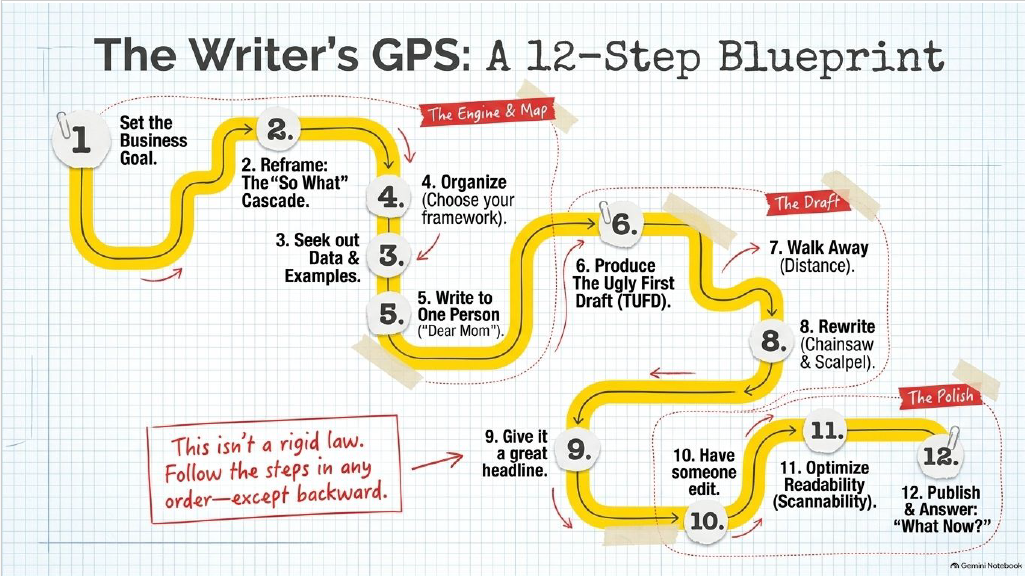
The biggest lesson from the lecture was that good writing is a process, not a magical event. But for businesses, I would add something else:
Better writing usually begins with better thinking.
Know your target audience.
Understand the problem they are trying to solve.
Choose the right format.
Have a clear point of view.
Write the first draft.
Edit ruthlessly.
Use search engine optimization to help the right people find it.
And give the reader an appropriate call to action when there is a logical next step.
That system works whether you are creating web copy, email copy, long-form content, case studies, press releases, or posts for social networks.
And do not let perfection become another excuse not to publish.
The final four words of Everybody Writes capture that nicely:
Done is better than perfect.
Get the useful version out.
Learn from it.
Then make the next one better.
Want Better Marketing and Better Business Decisions?
Good content is only one part of building a stronger business. If you want help sharpening your marketing, improving your strategy, or figuring out where your next growth opportunity is, you can work with me directly.
And if you’re not ready for that, keep an eye on JohnnyBaskin.com. I’ll keep sharing practical advice on content, SEO, digital marketing, AI, advertising, entrepreneurship, and the tools and strategies I think are actually worth a business owner’s time.
No fluff. Just ideas you can put to work.