
“We need more leads.”
It is a reasonable thing for a business owner to say. More people asking about your services should mean more opportunities to grow.
But I want to know what happens to the leads you already have.
What do they see when they click? What are you asking them to buy? What happens if they are interested but not ready? And if they become a customer, is there a sensible next step?
Those questions were at the centre of two recent workshops I led around Russell Brunson’s DotCom Secrets. We explored value ladders, customer relationships, and how the sales process affects what a business can afford to spend on marketing.
The idea I wanted people to take away was straightforward: before asking an ad to work harder, look at the business experience behind it.
A Better Ad Can Only Take You So Far
In the presentation, we looked at Brunson’s account of FitLife.tv, a business whose customer acquisition costs exceeded the price of its initial product.
You can see the problem. If bringing in a customer costs more than the first sale generates, increasing the advertising budget needs a stronger justification than “we’ll make it up in volume.”
Brunson’s diagnosis focused on the funnel: the sequence of offers and decisions that follows someone’s initial interest.
That is a useful way to examine a struggling campaign.
Maybe the ad needs work. Maybe the targeting is wrong. But perhaps people arrive expecting something different. Perhaps the first purchase asks for too much commitment. Perhaps satisfied customers would happily buy another relevant service, but nobody offers it.
Each situation needs a different fix.
Changing a headline is easy. Understanding where people lose interest takes more work. I would rather do that work before spending more money sending people through the same experience.
Give People a Sensible First Step
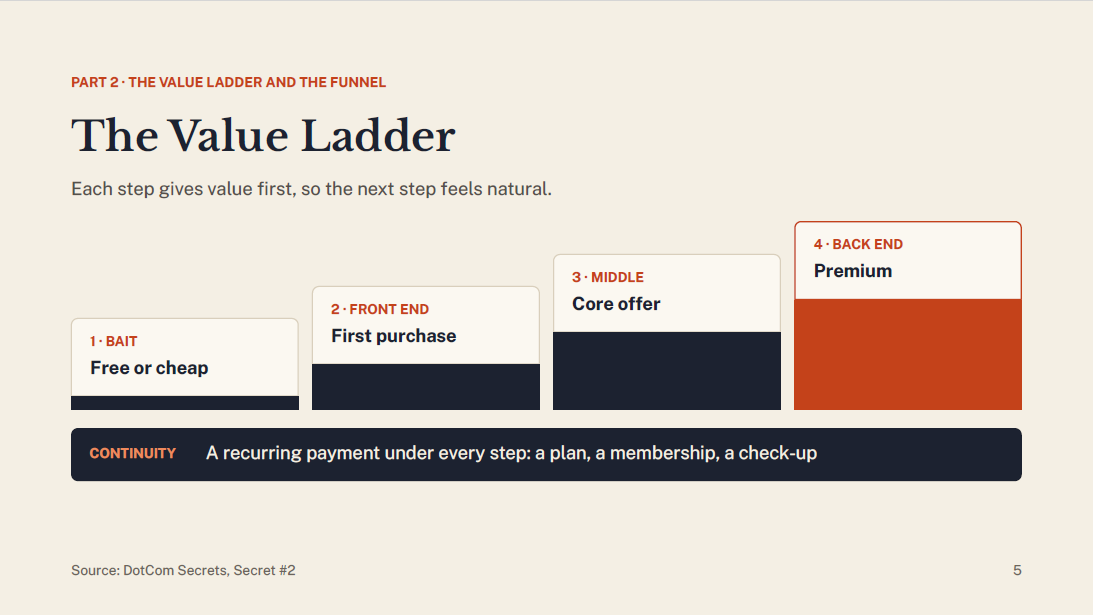
One of the main frameworks we covered was the value ladder.
The idea is that a business can offer different levels of help, starting with an accessible introduction and progressing toward more substantial services.
Think about hiring someone you have never worked with.
You might be interested in their expertise without being ready to commit to a large project. A smaller, useful engagement gives you a chance to experience how they think and work.
That first step still needs to solve something. A cheap offer that wastes your time does not make the larger offer more appealing.
And the next step needs to make sense.
If someone buys a guide but struggles to implement it, help with implementation could be valuable. If they complete an initial project and uncover a larger need, a more comprehensive service might be appropriate.
The question I would ask is: What would help this customer make progress from here?
That gives you a much better starting point for an additional offer than simply deciding you want a bigger transaction.
More Revenue Does Not Automatically Mean More Profit
The workshops also explored why customer value matters when competing for attention.
Imagine two businesses offering a similar introductory service. One earns a single purchase. The other delivers a good experience and earns repeat business over time.
The second business may have more room to invest in acquiring a customer.
But you have to understand the costs behind that revenue. Additional services require time, labour, materials, or support. Money arriving six months from now also does not pay today’s advertising bill.
This is why I want conversations about marketing to include customer value, acquisition costs, and profitability.
Without those numbers, a lead can look expensive or cheap based mostly on how someone feels about the invoice.
Knowing what a customer contributes over time gives you a stronger basis for deciding what you can spend to acquire one.
Make Sure the Promise Survives the Sales Call
One example discussed in the follow-up workshop involved advertising a $6,000 price when the actual cost customers encountered was $10,000.
That gap creates a problem before the sales conversation has properly started.
Someone responds based on one expectation, then discovers a substantially different commitment. Now the salesperson has to explain the difference and rebuild confidence.
A campaign can generate plenty of enquiries under those conditions. The enquiry count alone will miss what is going wrong.
I would rather explain the offer clearly from the beginning. What does the advertised price include? What costs extra? Who is the service suitable for? What limitations should someone understand?
You may hear from fewer people when those details are clear. You also give the people who do respond a more accurate basis for deciding.
The ad, landing page, and sales conversation should describe an offer the business can actually deliver.
Start With What the Customer Understands
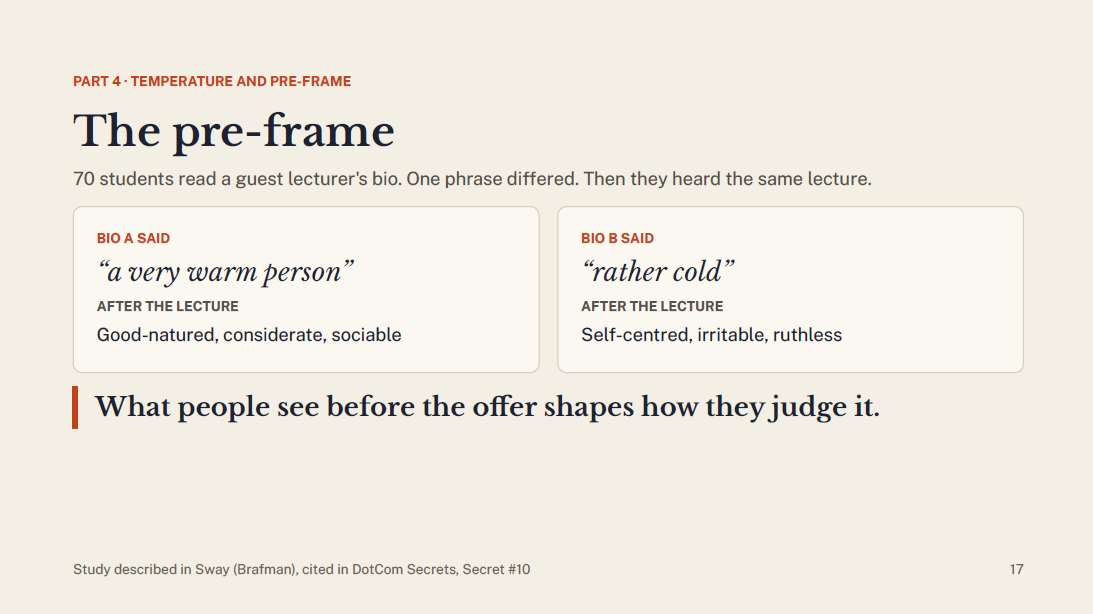
Another useful concept from DotCom Secrets is audience temperature.
Someone who already knows your work brings a different level of familiarity than someone encountering your business for the first time.
We often forget that when writing marketing.
Inside a business, the service names, methods, and benefits feel obvious. Outside it, people may only recognize the problem they want solved.
A business owner might know that enquiries have slowed down. They may have no particular interest in hearing about funnel architecture.
Start with the situation they recognize. Explain enough to help them understand their options. Then introduce the service in that context.
The same principle applies to the size of the decision. A person discovering you through an ad may need examples, explanations, and evidence before they are comfortable booking a substantial engagement.
Give them a way to build that confidence.
Have Something Useful to Say After They Leave
Most people will not make a decision during their first visit.
If your entire approach depends on an immediate purchase or enquiry, you have very little opportunity to continue the conversation.
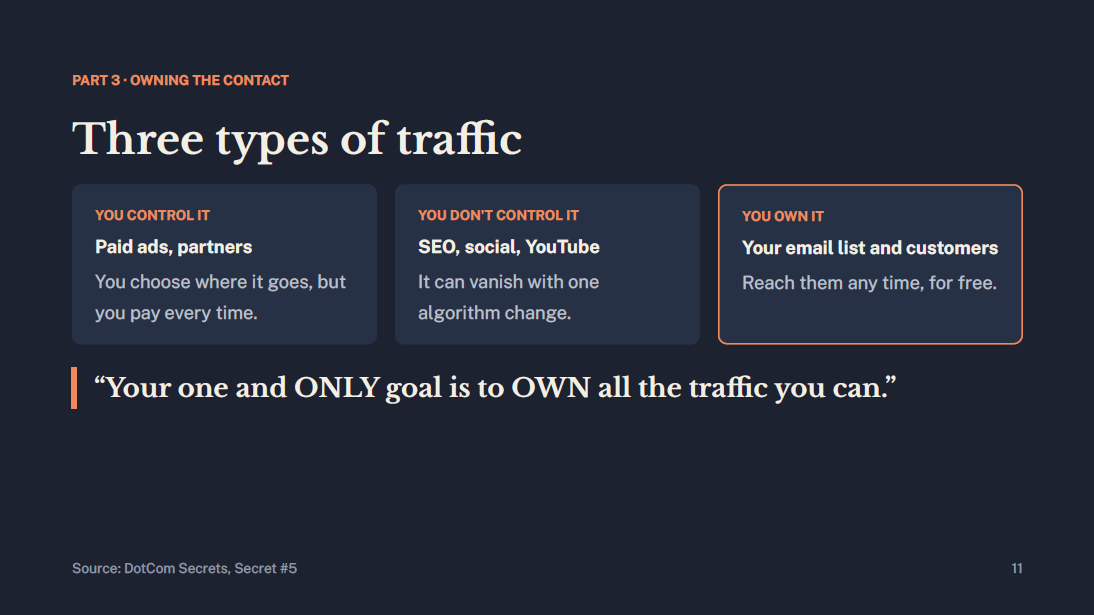
We discussed email as one way to build that relationship when someone chooses to hear from you.
Brunson’s welcome sequence uses a connected story across five emails. What interests me about that approach is the continuity. Each message gives the reader a reason to care about the next one.
A business could explain a common mistake, show how it affects the customer, share an example, and help the reader understand what a better approach involves.
There needs to be substance behind the sequence. Sending five emails because a framework says five will not make them useful.
Tell people something worth reading. Make the connection to your offer clear. Give them a reason to trust your judgment over time.
Apply the Questions to Your Own Business
During the follow-up workshop, we examined our own sales process.
A free competitor report can open a conversation. But we also discussed whether comparisons put too much emphasis on what other businesses are doing.
A competitor running more ads does not automatically tell us what a particular owner needs.
What are they trying to build? Which services do they want to grow? What would make the business more profitable or easier to operate?
Those answers should shape the recommendation.
I proposed a paid, standalone strategy report as a possible step between the initial audit and a larger service engagement. It would need to provide useful direction on its own, with a clear purpose for the client.
That is the value ladder question applied to our own business: is there a missing step that would help someone make a better decision?
Pick One Step and Improve It
You do not need to rebuild your entire marketing system to use these ideas.
Follow one customer journey from the first ad or search result through to the purchase and follow-up.
Look for the point where expectations become unclear, the commitment feels too large, or the conversation simply stops.
Then improve that step and measure what happens.
In the presentation, I used a simple reminder: “Try it. Test it. Tweak it.”
That is how I would approach this. Choose an offer that makes sense for your customer. Explain it honestly. Watch how people respond, and use what you learn to make the next decision.
Before you pay for more attention, make sure you have somewhere worthwhile to take it. If you’re getting clicks and enquiries but struggling to turn them into profitable business, get in touch with me. Let’s look at what happens after the click and find the next step worth improving.