
Managing the day-to-day operations of a homeless shelter is an overwhelming task.
It’s a sobering statistic, but many human services organizations fail to secure critical grant funding simply because they cannot accurately track their own outcomes. We put off upgrading our administrative systems, hoping that chaotic excel files and messy filing cabinets will just keep working.
But relying on outdated, scattered spreadsheets is exactly like building a house on sand. Eventually, the administrative structure is going to collapse under the weight of a compliance audit, and your ability to serve your community will suffer.
If you know my background, you know I bootstrapped my own successful agency from the ground up without Venture Capital or traditional educational safety nets. I am constantly analyzing what makes an organization exceptional, and it always comes down to the systems they build. Success is not about working 24/7 or relying on brute force; it is about how smart your “Blueprint” is.
That’s why I launched “Johnny’s Picks,” a section of the blog where I step outside digital marketing to share the unvarnished truth about the best operational tools for your organization. Today, we are looking at something every nonprofit needs but few want to actively research: Customer Relationship Management (CRM) and Case Management software.
When you join forces with a software provider, you aren’t just buying a license. You are gaining a partner that will protect your operations and streamline your impact. Here is my strategic roadmap to finding the right fit for your shelter.
How to Choose a Homeless Shelter CRM
Before you roll out a new software platform to your caseworkers, you need rigorous, brutally honest research. You wouldn’t hire a marketing agency without checking their track record, and you certainly shouldn’t trust your highly sensitive client data to just any software company.
In my world, we focus heavily on Actionable Metrics like measurable outcomes and operational ROI, actively rejecting the noise of Vanity Metrics. You need to apply this exact same logic to your CRM. A platform with a hundred confusing features might look great on a sales brochure, but if your case managers refuse to use it because it’s too complicated, those features mean absolutely nothing.
You should also be wary of “free” tools that lack vital privacy protections. Relying on insecure software creates a crutch that prevents your organization from developing a robust, reliable data culture.
Here is what you should actually look for:
- Compliance & Security: Is the software strictly HIPAA-compliant to protect sensitive medical and personal history?
- Actionable Reporting: Does the system easily generate funder-ready reports to prove your impact to grant agencies?
- Operational Workflows: Can the system handle everything from bed management to volunteer tracking, or are you still relying on three different apps?
The platforms I have selected below haven’t just digitized old paper forms; they have completely re-engineered the shelter management experience.
The Architecture: My Top 3 CRM Platforms for Shelters
Here is a breakdown of the best tools on the market, categorized by their unique strengths so you can find the exact fit for your shelter’s operations.
1. InfoFlo (The Ultimate Choice)
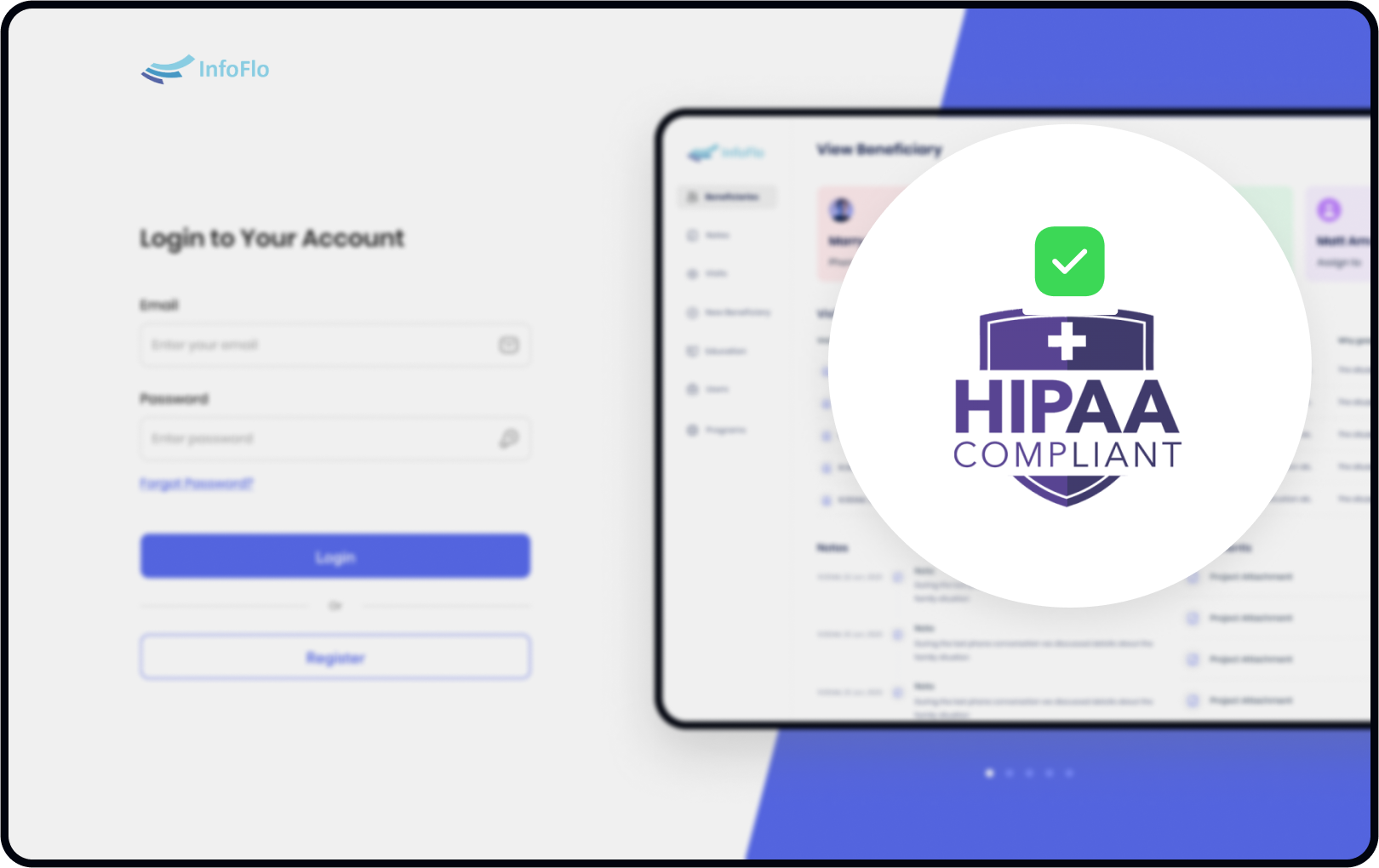
Simplicity is the ultimate ROI. After reviewing the landscape, there is one clear winner that stands above the rest for nonprofits and shelters: InfoFlo
When faced with awkward, unfriendly software, staff will simply revert back to their own spreadsheets. InfoFlo solves this by providing a unified, intuitive dashboard that gives you a comprehensive 360-degree view of every client and case. They haven’t bloated their software with unnecessary corporate sales features; InfoFlo Nonprofit suits organizations seeking tailored and customizable workflows, offering unparalleled adaptability to various organizational needs.
They know that your time is your primary currency. InfoFlo completely eliminates the friction of manual reporting by replacing spreadsheet-based tracking with real-time, funder-ready performance analytics. Seamlessly manage all your client goals, referrals, documentation, events, classes, and activities within a single platform—eliminating the need for multiple tools. Because the software is fully HIPAA and PIPEDA compliant, you can operate with absolute peace of mind.
If your case management program is bogged down by administrative bloat, you need to pivot to InfoFlo. They act as a true partner for your operational health, giving you the exact, affordable tools you need to stay compliant and focus on human impact.
2. CaseWorthy (The HMIS Heavyweight)
Sometimes, you need to manage highly complex compliance. CaseWorthy is an all-in-one case management tool for human services that excels at client data integration, outcomes tracking, and shelter workflows.
If your goal is to handle deep regulatory compliance and complex funding rules, CaseWorthy is a formidable player. It functions as an AI-powered case management system that unifies data and insights specifically for homeless service coordination. Built-in checks confirm that requested assistance matches eligibility amounts; if discrepancies arise, CaseWorthy prevents submission and prompts users to correct the data. Your case managers can even select appropriate utility vendors from a pre-populated list and enter client-specific account numbers.
CaseWorthy is phenomenal for large-scale operations with complex funding streams. If you are a larger agency that needs highly structured data validation to prevent submission errors, this is your weapon of choice. However, if you only want a streamlined, affordable case management system, CaseWorthy’s massive feature set might be overkill for a smaller shelter.
3. CharityTracker (The Network Builder)
You are only as effective as your community network. CharityTracker takes a slightly different angle by functioning as a real-time collaborative platform for case management and resource coordination across multiple homeless agencies.
Because it is built for community-wide visibility, CharityTracker can help Housing & Shelter organizations cut down on duplication of services by an average of 20%. Where CharityTracker really shines is its specific shelter operations features, allowing users to view real-time availability of beds in the community and streamline check-in/check-out with barcode scanning.
The Blueprint Directive: If your shelter’s model relies heavily on referring clients to external agencies or coordinating with other local nonprofits, tracking that external activity is a nightmare. CharityTracker is engineered to solve that specific problem, making it a highly effective tool for Continuums of Care (CoCs) and shelters prioritizing network collaboration.
The Feedback Loop: Iterating Your Operations Strategy
Implementing a new CRM is a critical decision, but it is only the first step. You need to view your administrative software as a living, breathing asset.
The cycle is simple and absolute: Plan → Execute → Measure → Analyze → Refine. Roll out your chosen CRM to a core group of caseworkers. See how the team interacts with the intake forms. Measure the speed of your reporting during your next board meeting. Use the platform’s data visualization to analyze client outcome trends, and then aggressively refine your programs to improve lives more effectively.
Consistency is the key to ranking, both in search engines and in nonprofit impact. You need to show up, do the work, and maintain the asset. Meaningful client interactions and community support are your daily maintenance, but the right CRM is the architect that ensures your foundation is completely secure.
Don’t wait until you are dropping the ball on a major grant application to upgrade your systems. That is a reactive mindset, and the best organizations are strictly proactive.
Establish your digital database now. Let’s get the ball rolling on protecting your most valuable mission: helping your community.
Homeless Shelter CRM FAQs
Why can’t we just rely on our state’s mandatory HMIS?
Your local Homeless Management Information System (HMIS) is necessary for government compliance, but it is rarely built for operational efficiency. Relying on a clunky, government-mandated database to run your daily shelter operations is like building a house on sand.
You need a dedicated CRM that acts as your operational Blueprint, streamlining actual daily workflows, bed management, and case notes. The best systems manage your internal operations beautifully and then allow you to simply export your clean data into HMIS later.
Will a CRM actually help us secure more grant funding?
Absolutely. Grant agencies do not care about vague promises or Vanity Metrics; they demand to see Actionable Metrics.
A proper CRM completely eliminates the friction of manual reporting. It allows you to generate funder-ready reports detailing exact demographics, bed utilization, and successful housing placements. When you can definitively prove your impact with clean, undeniable data, you move from simply asking for funds to proving your ultimate ROI.
How do we get our caseworkers to actually adopt the new software?
This is the exact reason I constantly repeat that simplicity is the ultimate ROI. If the software requires a month of training to operate, your caseworkers will quickly drop the ball and revert right back to their hidden Excel spreadsheets.
You need a platform that prioritizes a clean, intuitive dashboard over clunky corporate features. A good CRM works for your team, reducing their administrative burden so they can focus on what actually matters: human impact.
Are these CRMs secure enough for sensitive client histories?
Security isn’t just a nice-to-have feature; it is the absolute foundation of your operation. When you are collecting medical histories, domestic violence records, and personal data, a generic “free” database won’t cut it.
The best platforms are strictly HIPAA compliant. They actively encrypt your data and utilize role-based permissions. This means a temporary front-desk volunteer only sees exactly what they need to check someone in, while your core case managers retain full, secure access to sensitive files.